



Reviewed for Accuracy and Trust
The clinical information provided below is reviewed and supported by our expert in surgical management, Dr. Loong Yik Yee, Consultant Surgeon, ensuring the highest clinical standards.
8 December, 2025

If you are experiencing certain unexplained symptoms, clinical guidelines dictate that you require an urgent referral for Colonoscopy within two weeks.
If you have any of the following signs or symptoms, you should seek immediate evaluation, as you may require an urgent referral for a Colonoscopy:

Unexplained Bleeding or Anaemia
This includes unexplained iron deficiency anaemia or rectal bleeding that is fresh or blood mixed with stool

Change in Bowel Habits
A persistent and unexplained altered bowel habit, especially if alternating between constipation and diarrhoea.

Unexplained Weight Loss or Lumps
Significant, unintended loss of weight or appetite, or a palpable mass detected during a physical examination.
When you consult a primary care physician, they will perform a focused history and physical examination, including a Digital Rectal Examination and Proctoscopy. These preliminary steps guide the subsequent urgent referral for a Colonoscopy if high-risk signs are found.
Knowing your risk category is key to choosing the correct test:
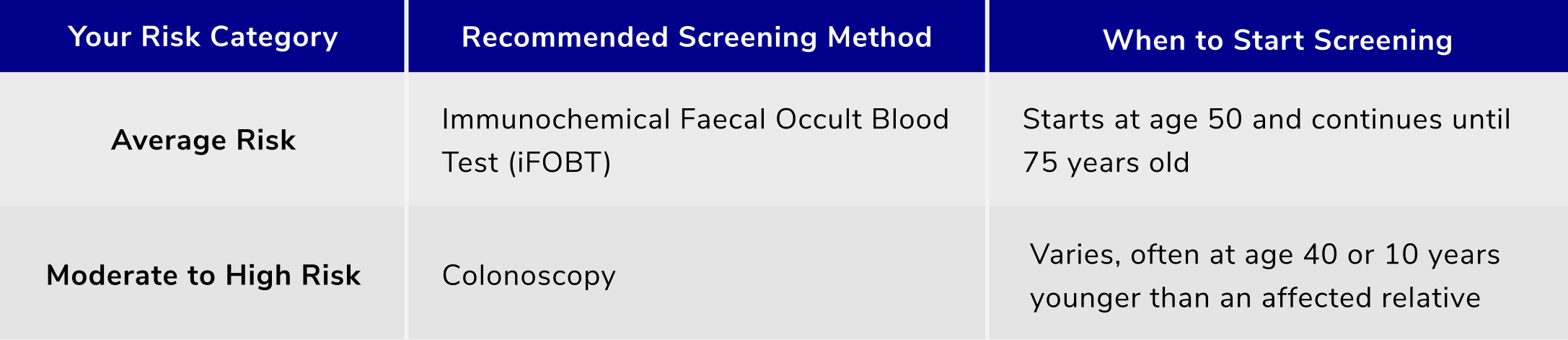
If you have a history of CRC in your family, you may be automatically moved into the moderate or high-risk category, mandating an early Colonoscopy.
You have ≥ first-degree relative (FDR, like a parent or sibling) with CRC. You will require a Colonoscopy, often starting at age 40.
This involves family history suggestive of hereditary colorectal cancer syndromes (e.g., Lynch Syndrome or FAP). If these syndromes are suspected, referral for clinical genetics service for genetic risk assessment is necessary.
The Colonoscopy procedure is typically performed under sedation or light anaesthesia, ensuring you are comfortable throughout the process. Our team will fully explain the procedure and what to expect during recovery.
If a tumour is found, the diagnosis will be standardised using the TNM (tumour-node-metastasis) staging system. Treatment is personalised based on the disease stage and will be guided by a multidisciplinary team approach for advanced cases.
If you are 50 or older, or if you recognise any of the urgent red flags above, taking action now is the most important step you can take for your long-term health.

Life Care Diagnostic Medical Centre Sdn. Bhd. 200401034597 (673106-V)
Bangsar South
WhatsApp: 0122343610
1st Floor, Wisma Lifecare,
No. 5, Jalan Kerinchi, Bangsar South,
59200 Kuala Lumpur
Cheras South
WhatsApp: 01127213620
19A-2 & 19B-2, Block E, Kompleks Komersil Akasa,
Jalan Akasa, Akasa Cheras Selatan,
43300 Seri Kembangan, Selangor
Operating Hour:
Monday – Friday: 8.00am – 5.00pm
Saturday: 8.00am – 1.00pm
Sunday & Public Holidays: Closed